What to Do With €1,000 in 2026 — 12 Practical Ideas

You’ve managed to set aside €1,000 and you’re wondering how to use it best? That’s an excellent initiative. Far from being a trivial amount, this sum is a real springboard, capable of laying the first stones of solid financial wealth or funding a project that matters to you.
In 2026, with traditional savings accounts whose returns struggle to keep up with the cost of living, letting this money sit idle would be a shame. So the question is no longer whether you should do something, but what to do in practical terms.
Whether you’re cautious, bold, or simply curious, there’s a strategy that fits. From secure options to more dynamic investments, not to mention personal projects, let’s explore the most relevant ways to grow this capital.
Before investing: the 3 non-negotiable steps
Putting €1,000 to work isn’t something you do on a whim. Before choosing a financial product, a quick audit of your personal situation is essential. Ignoring these fundamentals means risking costly mistakes—especially damaging when your starting capital is modest.
1. Assess your situation: debts and emergency savings
The first golden rule is simple: do you have high-interest debt, such as consumer credit or a bank overdraft? If the answer is yes, your absolute priority is to pay it off. The interest rate on this debt (often above 5%, even 10%) will almost always be higher than the return you could reasonably expect from a risk-free investment. Paying off debt is like earning a guaranteed, tax-free “return” equal to its interest rate.
Next, ask yourself about your safety cushion. Emergency savings is money that’s immediately accessible, placed in a risk-free vehicle, meant to cover unexpected events (car trouble, an unforeseen bill, job loss). The standard recommendation is to have 3 to 6 months of living expenses. If your €1,000 is all your savings, it should form the foundation of this safety reserve—not be invested in risky assets.
Emergency savings first, investing second
Consider these €1,000 as the first brick in your financial fortress. If you have no savings set aside, put them into an on-demand savings account such as the Livret A. This isn’t a missed opportunity, but the essential condition for investing calmly later—without having to sell your assets urgently, potentially at a loss, if hardship strikes.
2. Define your time horizon and your goals
What are you planning to do with these €1,000? The answer completely determines the strategy to adopt.
- Short term (less than 3 years): Planning a trip, a down payment for a major purchase? The priority is capital preservation. Risky investments should be avoided.
- Medium term (3 to 8 years): You want to fund a project such as a real-estate down payment. A moderate level of risk can be considered to seek a return above inflation.
- Long term (more than 8 years): You’re starting to prepare for retirement or simply want to grow capital over time. It’s on this horizon that more dynamic investments, like stocks, can fully express their potential thanks to the power of compound interest.
3. Determine your risk profile
Your risk tolerance is a crucial personal variable. Would you be comfortable if the value of your investment temporarily fell by 10%, 20%, or more? We generally distinguish three major profiles:
- Cautious: Capital safety is your absolute priority. You accept a low return in exchange for a total or near-total guarantee of not losing your principal.
- Balanced: You’re looking for a compromise between safety and performance. You’re willing to accept a moderate share of risk in hopes of a more attractive return.
- Dynamic: Your main objective is long-term performance. You accept significant volatility and a risk of capital loss in exchange for higher upside potential.
Once these three steps are validated, you’re ready to explore the concrete options available to you.
Low-risk options: the base of your financial pyramid
For a cautious profile or to build your emergency savings, these solutions are the most suitable. Liquidity and safety are their main strengths.
Idea 1 & 2: Regulated savings accounts (Livret A, LDDS)
Must-haves, the Livret A and the Livret de Développement Durable et Solidaire (LDDS) are the simplest and safest options. Your capital is guaranteed by the State, funds are available at any time, and interest is fully exempt from income tax and social contributions.
In 2026, with a rate that should stabilize around 1.5% to 2%, their real return (after inflation) is low, or even negative. Their role isn’t to make you wealthy, but to secure part of your savings.
Idea 3: the livret d'épargne populaire (LEP)
If your income allows, the LEP is by far the best risk-free savings account. Its yield is indexed to inflation and higher than the Livret A (around 2.5% net expected in 2026). It combines all the advantages: guaranteed capital, immediate availability, and full tax exemption. If you’re eligible, it should be your absolute priority for your emergency savings.
Idea 4: Euro funds in assurance-vie
Assurance-vie is a versatile tax wrapper. By placing your €1,000 into a euro fund, you benefit from a capital guarantee (net of fees). Euro fund returns are enjoying a comeback and often exceed the Livret A.
Even if the money remains accessible, the main advantage of assurance-vie lies in its favorable tax treatment after 8 years. Opening a policy as early as possible, even with a small amount, helps you “start the clock” and lock in the tax holding period.
Solutions for a moderate return: diversify cautiously
If you already have emergency savings and an investment horizon beyond 3–5 years, you can aim for a better return by accepting a controlled level of risk.
Idea 5: “Paper real estate” with SCPI
Investing in property with €1,000? It’s possible thanks to Sociétés Civiles de Placement Immobilier (SCPI). Instead of buying a property, you buy shares in a company that owns and manages a large real-estate portfolio (offices, retail, warehouses...).
You then receive rental income in proportion to your investment, with no management constraints. It’s an excellent way to gain diversified exposure to real estate. Yield generally ranges between 4% and 6% per year, but capital is not guaranteed and liquidity is limited.
Idea 6: Real-estate crowdfunding
Another gateway into real estate is participatory financing. You lend money (via bonds) to a developer to finance a specific construction or renovation project. Minimum tickets are often set at €1,000.
The return potential is higher than for SCPI (between 8% and 12% per year), but so is the risk. Your capital is locked up for a set period (12 to 36 months), and the success of the operation depends on a single project. This is an investment to consider for diversifying a small portion of your portfolio.
Idea 7: assurance-vie in units of account (managed portfolios)
Within an assurance-vie, you can also invest in units of account (UC). These are linked to financial markets (stocks, bonds...) and therefore carry a risk of capital loss. For a beginner, managed portfolios (gestion pilotée, or discretionary management) is a very relevant option. You delegate investment choices to professionals who allocate your capital according to the risk level you’ve chosen (cautious, balanced, dynamic).
Dynamic investments: aiming for long-term performance
For bold profiles with a long time horizon (more than 8 years), these €1,000 can be the starting point of an ambitious growth strategy. Volatility will be higher, but so will upside potential.
Understanding risk
Dynamic investments offer the best return prospects, but they come with a risk of capital loss. Only invest money you can afford to lose, and never put all your savings into these vehicles. Diversification remains your best ally.
Idea 8: ETFs via a PEA (French equity savings plan)
To invest in the stock market simply and at low cost, ETFs (Exchange Traded Funds), also called “trackers,” are fantastic tools. These funds passively replicate the performance of a stock index (such as the CAC 40 or the S&P 500).
By buying a single “World” ETF, you gain exposure to thousands of companies across the globe, ensuring maximum diversification. The Plan d'Épargne en Actions (PEA) (French equity savings plan) is the ideal tax wrapper to hold these ETFs, as it offers an income tax exemption on capital gains after 5 years of holding.
Idea 9: Investing in carbon allowances (EUA)
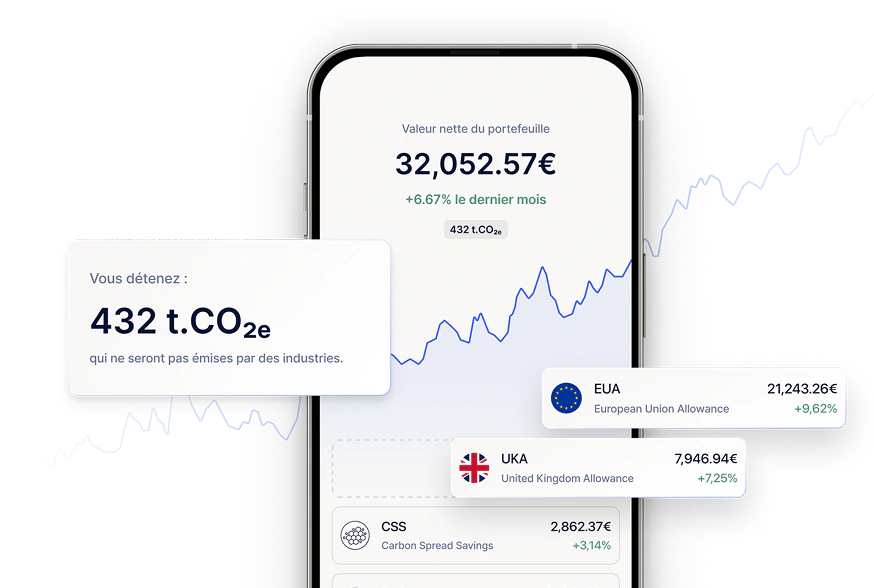
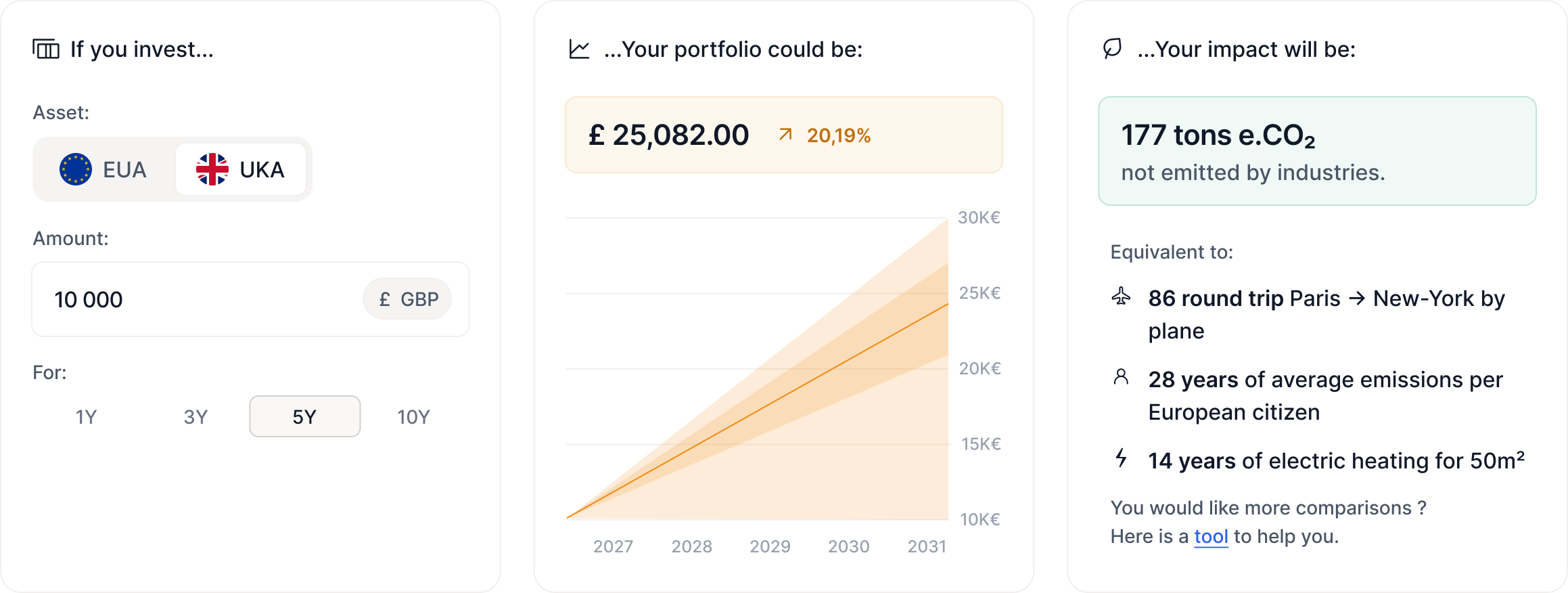
An emerging, values-driven asset class is gaining popularity: the European regulated carbon market. The principle is simple: European industrials must buy “rights to pollute” (carbon allowances, or EUA) to offset their CO2 emissions. As an investor, you can now buy these allowances.
By taking allowances off the market, you help push up their price, which financially incentivizes companies to accelerate decarbonization. It’s an investment that directly aligns environmental impact with potential financial performance. In France, the pioneering platform Homaio has democratized this access—historically reserved for institutions—with a minimum ticket set at €1,000, a threshold perfectly suited to our topic. This asset, uncorrelated with traditional markets, offers attractive historical performance potential, but also a risk of capital loss.
Idea 10: Direct stocks (fractional shares)
Buying shares of individual companies (“stock picking”) is riskier than investing via ETFs. However, for those who enjoy analyzing businesses, it’s a fascinating approach. With €1,000, it’s difficult to diversify enough. One solution is to buy fractional shares, which lets you purchase portions of very expensive stocks (such as LVMH or Apple) and build a varied portfolio even with a small budget.
Beyond investments: other ways to use €1,000
Growing your money doesn’t only happen through financial markets. Sometimes, the best investment is the one with no directly measurable return.
Idea 11: Invest in yourself
The best asset is you. Using €1,000 to acquire a new skill can deliver a return on investment far greater than any financial product. Whether it’s an online course to master software, language classes, professional coaching, or a driver’s license, these expenses increase your “human capital” and can lead to career opportunities and much higher income over the long run.
Idea 12: Create or launch a personal project
Do you have a side-business idea? €1,000 can be enough to get started. This sum can fund the creation of an e-commerce website, the purchase of initial inventory for crafts, equipment to launch a YouTube channel or a podcast, or an ad budget to test a concept. It’s a high-risk investment, but with enormous potential for personal satisfaction and personal gain.
Summary table: 12 ideas for your €1,000
A lump-sum investment vs. regular contributions
Investing €1,000 in one go provides immediate market exposure. However, to smooth out risk—especially on volatile vehicles like stocks—it’s often wise to complement this contribution with scheduled monthly payments (even modest ones, like €50). This strategy, called DCA (Dollar Cost Averaging), allows you to buy more shares when markets fall and fewer when they rise.
Having €1,000 is a wonderful opportunity. It’s not the amount that matters, but the approach you begin. By first securing your situation, defining your objectives, then choosing a strategy that fits you, you lay the foundations for healthy personal finance management.
Whether you choose the caution of savings accounts, the diversification of paper real estate, the dynamism of the stock market, or the impact of new assets like carbon allowances, what matters most is taking the first step. Action, even modest, will always be more rewarding than inaction.
Frequently asked questions (FAQ)
Is it better to invest €1,000 all at once or in several installments?
It depends on the vehicle. For a risk-free option like a savings account, a lump-sum deposit is simple and effective. For volatile investments like ETFs or stocks, investing all at once (Lump Sum) is statistically more effective over the long term, but psychologically riskier. For a beginner, it can be reassuring to spread the investment over several months to avoid entering at the market “high.” A good strategy is to invest the €1,000 and then set up regular monthly contributions.
What is the first thing to do before investing €1,000?
The absolute priority is to make sure you have sufficient emergency savings (equivalent to 3–6 months of expenses) in secure, available savings accounts. If these €1,000 represent all your savings, they should be allocated to that safety cushion. The second priority is to pay off any high-interest debt (consumer credit, overdraft).
Which fees should you watch with a small amount of capital?
With an amount of €1,000, fixed fees or high entry fees can significantly reduce your performance. Favor solutions with low management fees (such as ETFs, below 0.5%/year) and wrappers with no entry or deposit fees (offers from online brokers or certain assurance-vie providers). Always read the fee documentation carefully before subscribing.
Is it possible to lose all of my €1,000?
Yes—on certain investments, the risk of a total loss exists, even if it is rare within a diversified approach. Capital-guaranteed options (savings accounts, euro funds) protect you against this risk. For stock investments, crowdfunding, or non-traditional assets, capital is not guaranteed. Diversification (not putting everything in one place) is the best strategy to reduce this risk. Never invest an amount you cannot afford to lose.
Go further: invest in the carbon market
Homaio gives you access to European carbon allowances (EUAs), an asset class that combines potential financial performance with direct climate impact. Diversify your wealth with an asset uncorrelated from traditional markets, accessible from €1,000.