Financial Investments in 2026 — Guide to Risks, Returns, and Taxation

Choosing a financial investment can seem complex given the multitude of options available. Yet a methodical and informed approach makes it possible to navigate this world with confidence and make decisions suited to your personal situation.
The goal is not to find the absolute “best” investment, because it does not exist. An investment that is relevant for a short-term project will not be the right one to prepare for retirement. This guide aims to give you the keys to compare solutions and identify those that match your objectives, your time horizon, and your sensitivity to risk.
Financial investment: definition and criteria for choosing well
A financial investment consists of allocating a sum of money to a vehicle (a product or an asset) in the hope of generating a future gain, called a return. This return can take the form of interest, dividends, or a capital gain upon resale.
Unlike emergency savings, which must remain available at all times in current accounts or savings booklets, an investment generally fits into a longer timeframe. It commits your capital by exposing it to a certain level of risk in exchange for potentially higher performance.
How to compare an investment: risk, return, liquidity, time horizon, and taxation
To assess and compare financial investments objectively, five criteria are essential. They form an indispensable analysis grid before any decision.
- Risk of capital loss : This is the possibility of not recovering your entire initial investment. It is almost zero for regulated savings booklets but can be total with equities.
- Potential return : This is the expected gain from your investment, generally expressed as an annual percentage. A high potential return is systematically the counterpart of a higher risk.
- Liquidity : This is how easily and quickly you can get your money back. A Livret A is very liquid (immediate withdrawal), whereas a real estate investment is not (several months to sell).
- Investment horizon : This is the period during which you plan to keep your money invested. Some investments are designed for the short term (a few months) and others for the long term (more than 8 years).
- Taxation : These are the taxes and social contributions that apply to the gains generated (interest, capital gains). Taxation can vary greatly from one product to another and significantly influence the final net return.
Be vigilant about taxation
Tax rules change regularly. The information presented here is general in nature. It is essential to check the legislation in force at the time of your investment and make sure it matches your personal situation.
The best-known financial investments in France
Let’s review the main families of investments accessible in France, analyzing them through our five-criteria grid.
Savings booklets and cash management solutions
This is emergency savings par excellence. The Livret A, the LDDS (Livret de Développement Durable et Solidaire) or the LEP (Livret d'Épargne Populaire, subject to income conditions) are the best known.
- Risk : None. Capital is guaranteed by the State.
- Return : Limited, set by public authorities and indexed to inflation.
- Liquidity : Immediate. Money is available at any time.
- Horizon : Very short term. Ideal for emergency savings.
- Taxation : None. Interest is fully exempt from taxes and social contributions.
Assurance vie and euro funds or unit-linked funds
Assurance vie is a very flexible tax wrapper that provides access to two very different types of holdings.
The euro fund
This is a secure vehicle with guaranteed capital (excluding entry fees).
- Risk : Very low. Capital is guaranteed by the insurer.
- Return : Moderate, but generally higher than that of savings booklets.
- Liquidity : Good. Money can be recovered within a few days or weeks, although the value of the contract is in the long term.
- Horizon : Medium to long term (more than 8 years for optimal tax benefits).
- Taxation : Favorable after 8 years, with allowances on capital gains.
Unit-linked funds (UC)
These are holdings invested in financial markets (equities, bonds, real estate...).
- Risk : High. There is a risk of capital loss, because their value fluctuates up as well as down.
- Potential return : High, but with no guarantee.
- Liquidity : Identical to that of the euro fund.
- Horizon : Long term, to smooth out market fluctuations.
- Taxation : Identical to that of the euro fund, within the same wrapper.
PEA and equity investing
The Plan d'Épargne en Actions (PEA) (French equity savings plan) is a wrapper dedicated to investing in shares of European companies.
- Risk : Very high. Share prices can vary sharply, leading to a significant risk of capital loss.
- Potential return : The highest over the long term, but with high volatility.
- Liquidity : Good. Listed shares can be sold quickly. However, any withdrawal before 5 years results in the plan being closed (with some exceptions) and less favorable taxation.
- Horizon : Long term (more than 5 years) to benefit from the tax advantage.
- Taxation : Very attractive. After 5 years, gains are fully exempt from income tax (but subject to social contributions).
PEL and term deposits
The Plan Épargne Logement (PEL) and term deposit accounts (CAT) are savings products where capital is locked in for a fixed period in exchange for a return rate known in advance.
- Risk : None. Capital and the rate are guaranteed at subscription.
- Return : Fixed and known in advance, but often moderate.
- Liquidity : Low. Withdrawing money before maturity leads to penalties, or even plan closure for the PEL.
- Horizon : Medium term (4 years minimum for the PEL, from a few months to several years for a CAT).
- Taxation : Interest is subject to the prélèvement forfaitaire unique (“flat tax”) or, by option, the income tax scale.
SCPI and real estate
Sociétés Civiles de Placement Immobilier (SCPI) allow you to invest in commercial real estate (offices, retail) by buying units. It is an alternative to buying property directly.
- Risk : Moderate to high. Unit prices and the rents paid can vary. Capital is not guaranteed.
- Potential return : Attractive, in the form of regular rental income.
- Liquidity : Very low. Reselling units can take several months.
- Horizon : Very long term (more than 10 years), notably to offset high entry fees (around 10 %).
- Taxation : Income is taxed as rental income.
Which financial investment depending on your saver profile
Choosing an investment depends above all on your objectives and your risk tolerance. Three main profiles are generally distinguished.
- Conservative profile : Your absolute priority is capital security. The investments to prioritize are regulated savings booklets and the euro funds of Assurance vie. Returns will be limited, but your money will be protected.
- Balanced profile : You accept a measured level of risk to target a more attractive return. A good strategy is to diversify: a secure core (euro fund) complemented by market exposure via unit-linked funds in Assurance vie or a PEA.
- Dynamic profile : Your goal is to maximize long-term performance and you accept taking high risk, including capital losses. The PEA, direct equities, and the most aggressive unit-linked holdings will be your preferred vehicles.
Expert tip
Don’t forget that your profile can evolve. A young professional with a long horizon can afford to be more dynamic than someone approaching retirement. Reassess your strategy every year or during major life changes.
Where to invest 10.000 € today
Investing 10 000 € is an important first step. There is no single answer, but there is a method to follow.
- Build your emergency savings : First and foremost, make sure you have the equivalent of 3 to 6 months of expenses in a liquid, risk-free vehicle such as the Livret A or the LDDS. If you don’t have it, part of these 10 000 € should be allocated there.
- Define a time horizon : If you need this money in less than 3 years (a down payment for a property purchase, for example), prioritize the security of a euro fund.
- For the long term : If you don’t need this sum for 5 or 8 years, you can consider boosting its growth potential. A good strategy may be to allocate the remainder: part to an Assurance vie (for its flexibility) and another part to a PEA to start investing in equities and “start the clock” as early as possible to benefit from tax advantages.
Which investment for 100.000 €
With a sum of 100 000 €, diversification is no longer an option, it is a necessity. The goal is not to put all your eggs in one basket, to spread risks and capture different sources of performance.
A balanced allocation could look like this, as an educational example:
- 30% to 40% in euro funds (via one or more Assurance vie policies) : This is the secure foundation of your wealth, generating a moderate but stable return.
- 30% to 40% in equity markets (via a PEA and/or unit-linked funds in Assurance vie) : This is the performance engine of your portfolio, accepting volatility and the risk of loss.
- 10% to 20% in real estate (via SCPI) : To generate regular supplementary income and diversify into an asset class that is less correlated with financial markets.
- The remainder in emergency savings : In savings booklets to handle unexpected events without having to touch your long-term investments.
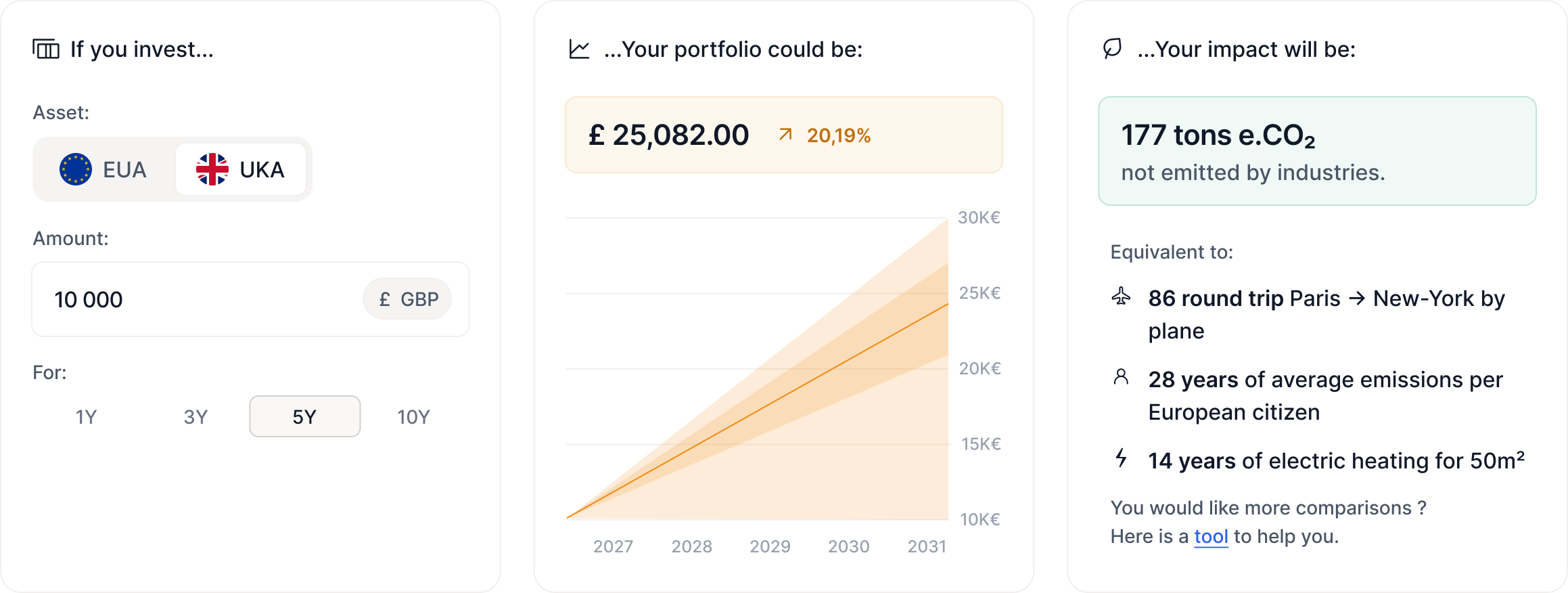
It is also possible to look at alternative asset classes to diversify your portfolio, such as assets linked to Carbon Markets and Carbon Finance, which may offer return prospects that are less correlated with traditional markets.
How much to invest to target 1000 euros per month
This question is common but calls for a cautious answer. To generate an income stream, you need a substantial starting capital. The theoretical calculation is simple: Required capital = Target annual income / Annual net return rate.
For 1000 € per month (i.e., 12 000 € per year), with a net return assumption of 4% per year, you would need capital of: 12 000 € / 0,04 = 300 000 €
A purely theoretical calculation
This figure must be taken with extreme caution. A 4% return net of fees and taxes, stable over time, is never guaranteed. It necessarily implies taking risk on part of the capital. In addition, inflation gradually erodes the purchasing power of this income stream over time.
Mistakes to avoid before choosing a financial investment
- Chasing returns without looking at risk : This is the most common mistake. A high return always hides a high risk.
- Ignoring fees : Entry fees, management fees, exit fees... They can significantly reduce your investment’s net performance.
- Lack of diversification : Putting all your money into a single vehicle, even if it performed well in the past, is very risky.
- Choosing an investment horizon that is too short for a risky product : Investing in equities for a 2-year project exposes you to having to sell at the worst time.
- Giving in to panic : Financial markets fluctuate. Selling after a sharp drop is often the best way to lock in losses.
FAQ on financial investing
What is the most attractive financial investment?
There is no “most attractive investment” in absolute terms. The best investment is the one that is suited to:
- Your objectives (prepare for retirement, buy a property, pass on wealth...).
- Your time horizon (3, 8, 15 years or more).
- Your risk tolerance (are you willing to see your capital temporarily decline?).
A young, dynamic investor will find the PEA very attractive, while a conservative person will prefer the security of the euro fund within an Assurance vie.
Is there a risk-free and profitable financial investment?
The return/risk trade-off is inseparable. A risk-free investment (100% guaranteed capital) will always offer a limited return (e.g., Livret A). To target higher profitability, you must accept taking on some risk. The key is to find the right balance—the one you are comfortable with.
What is the difference between saving and financial investing?
Saving is the portion of income that is not spent. It is often placed in risk-free and liquid vehicles (immediately available) to build “emergency savings.” Financial investing uses this saving in more or less risky vehicles and over a longer horizon, with the goal of growing it.
Should you diversify between Assurance vie, PEA, and real estate?
Yes, it is strongly recommended, especially for substantial wealth. These three wrappers are complementary. Assurance vie offers flexibility and access to a secure euro fund. The PEA is the equity performance engine with a major tax advantage. Real estate (via SCPI, for example) provides regular income and diversification that is less correlated with financial markets. Combining all three helps build a robust, balanced portfolio.
Go further: invest in the carbon market
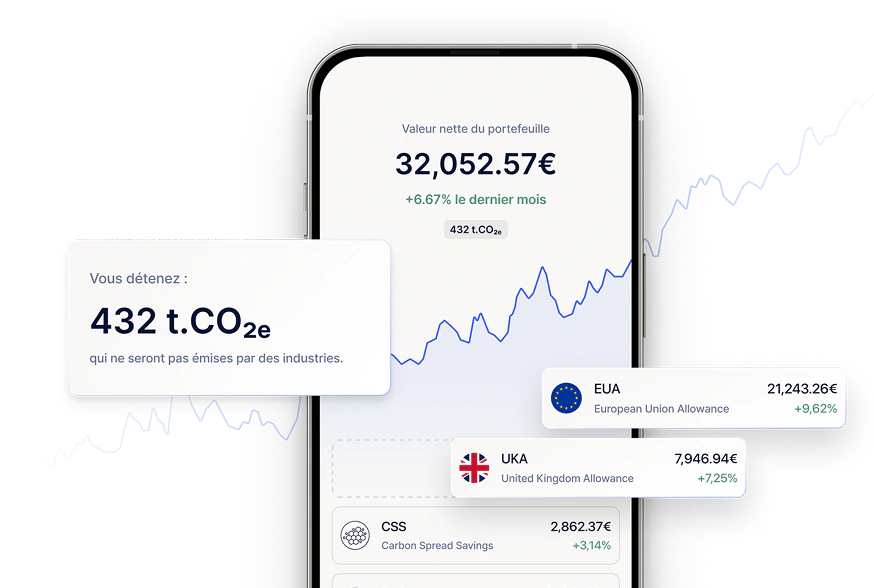
Homaio gives you access to European carbon allowances (EUAs), an asset class that combines potential financial performance with direct climate impact. Diversify your wealth with an asset uncorrelated from traditional markets, accessible from €1,000.