Blog
Carbon Market
Academic Travel Meets Climate Action: CEPR Partners with Homaio to Cut Its Carbon Footprint

Academic Travel Meets Climate Action: CEPR Partners with Homaio to Cut Its Carbon Footprint

Academic travel is inevitable, but its impact doesn't have to be. CEPR joins forces with Homaio to permanently cancel EU carbon allowances and take direct, measurable climate action.

As an international organisation, Centre for Economic Policy Research (CEPR) 's activities inevitably involve travel, and the carbon emissions that come with it. Committed to reducing the environmental impact of its operations, CEPR has launched a new Greener Travel Policy in partnership with Homaio, striking a balance between meaningful academic collaboration and sustainability.

The policy rests on two pillars: reducing travel-related emissions where possible, and compensating for unavoidable flights through a robust, transparent mechanism.

How it works

Homaio is a Paris-based company specialising in investment products with measurable climate impact. Through this partnership, CEPR gains access to Homaio's platform to purchase and permanently cancel European Union Allowances (EUAs) under the EU Emissions Trading Scheme (EU ETS).

Each cancelled allowance represents one tonne of CO₂ equivalent that can never be emitted by anyone else within the scheme. Homaio holds these physical allowances in the EU Registry, ensuring their definitive removal from circulation. Since the total supply of EUAs is strictly capped, every cancellation directly reduces the overall emissions capacity of the European system.

[[cta-nl]]

A pragmatic step, not a licence to fly freely

As CEPR President Beatrice Weder di Mauro puts it: "This is not a licence to fly without considering the consequences, but rather a pragmatic step to mitigate some of the harm associated with academic travel while keeping our research community connected."

Beyond carbon compensation, the partnership creates opportunities for collaboration between academic and financial communities to develop impactful climate investment solutions.

Permanently removing allowances to maximise impact

What sets this approach apart from traditional carbon offsetting is the permanent, irreversible removal of allowances from the market. Whether the goal is to offset a carbon footprint or simply to take meaningful environmental action, cancelling EUAs delivers a direct and measurable impact in the fight against climate change. By shrinking the pool of available allowances, this mechanism increases pressure on polluting industries and contributes to driving up the carbon price, strengthening the economic incentive to decarbonise.


Share this article :

Learn more

Carbon Market

UKAs and EUAs: Why Hold Both When You're Already Invested in European Carbon

If you're already invested in European EUAs, do you need to bother with UK UKAs? Short answer: yes. Long answer: the two markets are correlated at around 80% over time, but that correlation hides distinct dynamics (political, industrial, calendar-based) that make UKAs both linked and differentiated from EUAs. That's precisely what makes the combination interesting: an EUA core for liquidity and depth, a UKA satellite for political catch-up and the associated risk premium. Here's why.

July 13, 2026

Carbon Market

What is the Climate Impact of a UKA? One Tonne of CO₂ Pulled Off the Market, Measured and Verifiable

Holding a UKA does something simple and radical: it takes one right-to-emit tonne of CO₂ off the UK market. Not an offset, not a voluntary credit, not a tree-planting promise. A regulated allowance, accounted for by the State, that exits the system the moment a non-compliance investor holds it. It's what we call an additional climate action: measurable, verifiable, legally framed. Here's how it works, and why this impact is one of the most robust in today's climate-finance landscape.

July 13, 2026

Carbon Market

The UKA-EUA Convergence Play: Anatomy of a Catch-Up in Motion

May 2025, London summit: Keir Starmer and Ursula von der Leyen formally state their intention to link the UK ETS to the European system. A new term has been circulating among carbon analysts ever since: the Convergence Play. The mechanic is simple: UKAs trade today around 20% below EUAs, a discount that has already partially closed since May 2025. The residual mechanical upside is around +20 to +25%. Here's how it works, why it's happening now, and what the Swiss-EU precedent teaches us.

July 13, 2026

What if your savings funded the climate transition?

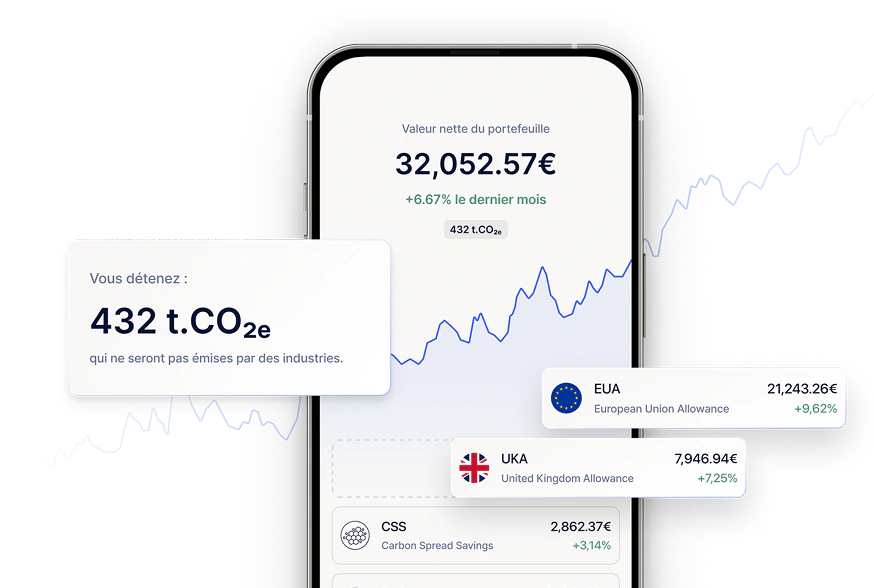
Homaio is the first platform that allows you to invest in European (EUA) and British (UKA) carbon quotas.

Diversify: integrate climate assets into your portfolio.
Discover Homaio
Finally access investments that combine
financial
 and
environmental
 performance
The Guide to Climate Investing

Investing in the climate without sacrificing performance: an accessible guide to understanding it all.

Thank you! Your submission has been received!
Oops! Something went wrong while submitting the form.
Free guide
The guide to investing in UK carbon allowances

Understanding the UK carbon market and its potential for investors.

Thank you! Your submission has been received!
Oops! Something went wrong while submitting the form.
Free guide
Newsletter
The Homing Bird

5 minutes a week to become unbeatable on climate finance.

Thank you! Your submission has been received!
Oops! Something went wrong while submitting the form.
Simulate your return in 2 clicks

Discover the added value you could have achieved if you had invested in one of our assets 1, 5, or 10 years ago.

Chat with an expert

Need help or more information? Schedule an appointment with our expert, who will be delighted to assist you!